

Rich Expectations: What Twenty Years of Research Reveals About Why the Wealthy Give
 Ben Tate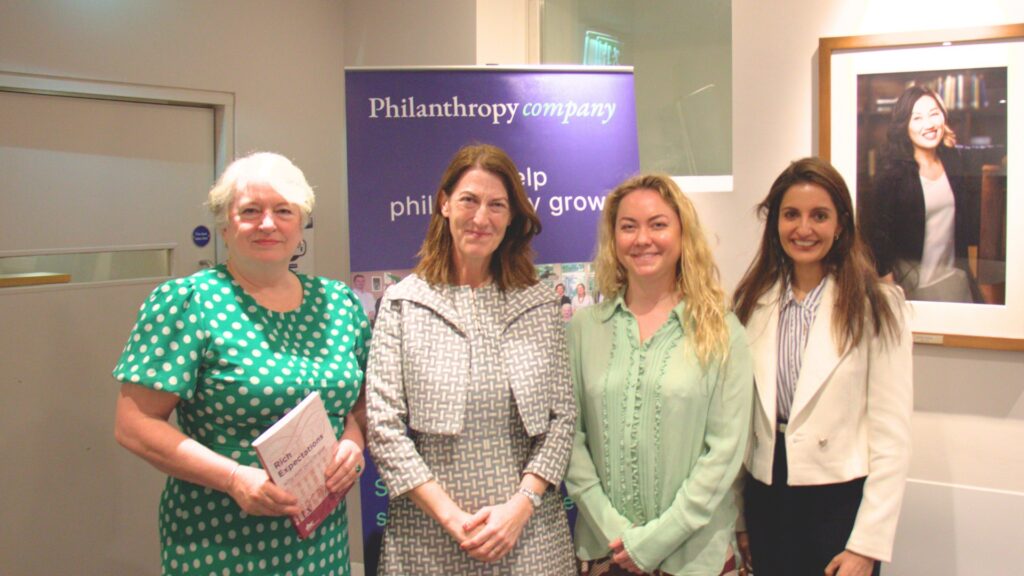
What happens when you track the giving habits of Britain’s wealthiest donors over two decades? You get Rich Expectations, the third instalment in a landmark research series by Professor Beth Breeze OBE, Rhodri Davies and Theresa Lloyd. Based on interviews with 88 major UK donors, the book offers a unique longitudinal picture of how and why the wealthy give.
I attended the book’s Oxford launch on 18 March 2026 chaired by Caroline Underwood OBE, jointly hosted by Philanthropy Company and Green Templeton College. The evening featured a keynote from Beth followed by a panel with Kate Symondson and Sonal Sachdev Patel. What emerged was a sharp, data-rich conversation about shifting donor motivations, and a powerful challenge to how the sector thinks about women and money.
Key Shifts in Donor Behaviour
The book’s data spans surveys conducted in 2012 and 2022, revealing some striking changes in what rich donors support and how they make decisions:
- Human services and welfare have overtaken arts and culture as the top cause area (60% vs 45%), reversing the 2012 picture.
- Support for environment, climate change and animal welfare rose from 29% to 43%.
- Those seeking philanthropy advice rose from 28% to 43%, with independent advisers (32%) the most consulted.
Insights and Takeaways
Women and philanthropy: seen differently, treated differently
Perhaps the most provocative strand of Beth’s keynote was her argument about gender. Her position is clear: women philanthropists don’t act differently, they are treated differently. She illustrated this with the story of the Bodleian Library at Oxford. We celebrate Sir Thomas Bodley for rescuing the ruined library, but he only had the resources to do so after marrying a wealthy widow yet nowhere is she named (Ann Ball in case you were wondering). Women’s philanthropic contributions, Beth argued, have been systematically written out of history.
This matters now more than ever. Around 70% of the projected $41 trillion intergenerational wealth transfer is expected to go to women, who inherit twice, outliving both parents and spouses. If advisers and charities continue to treat women as secondary stakeholders rather than primary decision-makers, they will miss the defining shift in philanthropic capital of our generation.
Panel perspectives
Kate Symondson, Head of Philanthropy at Alexander Square Partners and architect of The Symondson Foundation, spoke candidly about being used as a ‘conduit’ and ‘diversity hire’ in philanthropic spaces. Yet she also highlighted the power of intergenerational partnerships and closed with a striking call to prioritise how personal reflection might inform giving then action, not just reflection alone. It was a fitting challenge for a sector that can sometimes get lost in analysis.
Sonal Sachdev Patel offered a complementary perspective, arguing that donors must look beyond personal experience to where the need is greatest. “People fund what they see and what they know,” she said, “but what is the problem the UK is actually facing?” She emphasised the importance of economic growth as a driver of future philanthropy and questioned whether family foundations are doing enough to look beyond their own experience when deciding where to direct their support.
What This Means for the Sector
The data in Rich Expectations paints a picture of a donor population that is becoming more purposeful, more self-directed and more willing to seek professional guidance. The rise of strategic giving suggests that today’s wealthy donors are not waiting to be asked. They are setting agendas, defining impact frameworks and expecting charities to demonstrate results.
For philanthropy advisers, the growing demand for professional guidance (28% to 43%) signals that donors want structured, values-aligned support, not just tax planning. Advisers who can help donors navigate complex cause areas, connect with effective organisations and think long-term about family giving will be well positioned.
For charities, donors are increasingly choosing causes based on their own research and convictions rather than responding to personal asks. Organisations that invest in clear impact reporting, genuine donor engagement and long-term relationships built on trust will be best placed to attract and retain major support.
And the gender question cannot be sidestepped. As Beth reminded us, if we are a values-driven sector, then sexist behaviour, however subtle, should be nipped in the bud. The Great Wealth Transfer is not a future scenario, it is underway. The sector must adapt now.
Looking Ahead
As I left Green Templeton College, I was struck by how much the philanthropic landscape has shifted in the twenty years since Theresa Lloyd first asked in the first book of the series ‘Why rich people give’. The motivations seem to remain deeply personal along with, belief in the cause, a desire to make a difference and for some the search for purpose. But the way donors act on those motivations has changed profoundly.
Rich Expectations is a reminder that understanding donors is not a one-off exercise. It requires the kind of sustained, longitudinal research that Beth, Rhodri and Theresa have committed to over two decades. For those of us working in philanthropy advisory and fundraising, this book is essential reading.
The expectations are rich on every side. The question now is whether the sector can rise to meet them.
Rich Expectations: Why Rich People Give* by Beth Breeze, Rhodri Davies and Theresa Lloyd is published by the Directory of Social Change, in association with Pears Foundation and University of Kent (ISBN: 978-1-78482-133-3).
This event was organised by Philanthropy Company and produced jointly with Green Templeton College as part of the Conversations in Global Philanthropy series.
Benjamin Tate is a Philanthropy Advisory Researcher at Philanthropy Company.
Latest news and insights
In Search of Hope: A Conversation with John Nickson and Caroline Underwood OBE

The Humanitarian reset – 6 key trends shaping the INGO sector in 2026

International Fundraising East and West: Trends, Motivations and Practical Insights from the US and Asia (Parts 1&2)

Fundraising feasibility study: Purpose, Process and Strategic Value
What we do


Fundraising strategy
Active fundraising support
Training and development